


Page 6 - Demo
P. 6
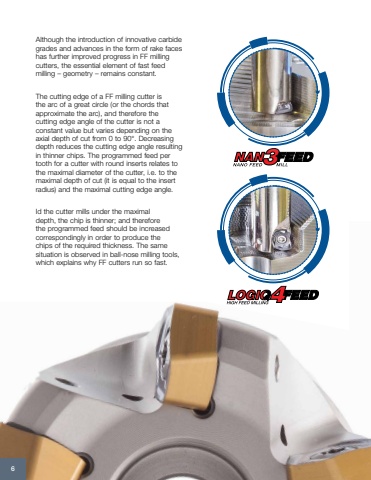
Although the introduction of innovative carbide grades and advances in the form of rake faces has further improved progress in FF milling cutters, the essential element of fast feed milling %u2013 geometry %u2013 remains constant.The cutting edge of a FF milling cutter is the arc of a great circle (or the chords that approximate the arc), and therefore the cutting edge angle of the cutter is not a constant value but varies depending on the axial depth of cut from 0 to 90%u00b0. Decreasing depth reduces the cutting edge angle resulting in thinner chips. The programmed feed per tooth for a cutter with round inserts relates to the maximal diameter of the cutter, i.e. to the maximal depth of cut (it is equal to the insert radius) and the maximal cutting edge angle.Id the cutter mills under the maximal depth, the chip is thinner; and therefore the programmed feed should be increased correspondingly in order to produce the chips of the required thickness. The same situation is observed in ball-nose milling tools, which explains why FF cutters run so fast.6


